
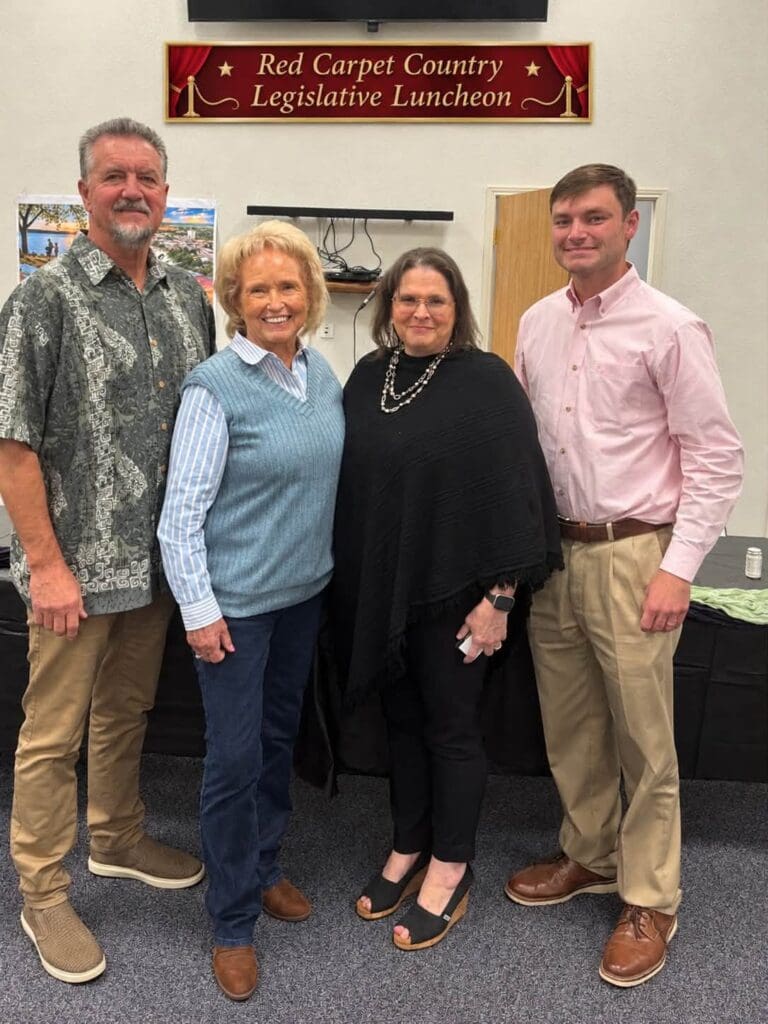
Water supplies, rural schools, tourism and local jobs were among the topics discussed during a recent legislative event hosted by Red Carpet Country. Angela Bruner and Cathy Howard attended representing Hennessey United.
Red Carpet Country is a regional tourism organization representing 16 counties in northwest and north central Oklahoma. The organization promotes the region’s history, museums, fishing, hunting and other attractions that draw visitors to local communities.
The event brought together legislative updates and discussion from State Reps. Carl Newton, and Mike Dobrinski and Peyton Burns field representative for Senator Lanford about issues affecting the region, from protecting groundwater to helping employees affected by the USG shutdown.
State Rep. Carl Newton said 2,677 bills were introduced during the last legislative session, with 465 passing, about 17%. He encouraged attendees to keep that in mind when attention-grabbing proposals make headlines, since many never advance to a committee hearing.
Education discussion centered on helping children read proficiently by the end of third grade. Newton explained that students first learn to read, then depend on reading to learn other subjects. He described second-grade assessments intended to identify students who need extra help, with additional testing in third grade if needed.
Newton also discussed continuing school cellphone restrictions, adding five days to the school year and developing guidelines for artificial intelligence in classrooms.
Rural school funding was another concern. Discussion included upcoming penalties tied to money districts carry over from one year to the next. Speakers questioned whether schools should be pushed to spend reserves simply to avoid a penalty. They also discussed districts that receive little or no money through the state funding formula because of local revenue, and how those schools can miss out when additional funding is distributed.
Water received considerable attention. Newton said irrigation accounts for about 74% of groundwater use, while public water systems account for about 16%. He discussed work with the Oklahoma Water Resources Board on spacing requirements for large groundwater wells to help prevent one user’s pumping from lowering a neighbor’s water supply. He said those efforts focus on high-volume users rather than household wells, small gardens or watering cattle.
Newton also discussed restrictions on groundwater use for evaporative cooling at data centers, while allowing closed-loop systems. He encouraged communities to establish guidelines before proposals arrive because facilities can vary greatly in their water and electricity needs. Another update involved $35 million being directed through the Oklahoma Water Resources Board for loans to community and rural water systems.
Canton Lake releases raised questions about how much water reaches Oklahoma City. Rep. Mike Dobrinski described dry river conditions that allow water to soak into the ground or evaporate along the route. A final report on the latest release’s efficiency was still pending at the time of the event. Possible unauthorized withdrawals during the release were also discussed. Water board personnel checked reported locations along the river, although some pumps were found to be connected to groundwater wells rather than surface water. Speakers also discussed stronger enforcement and more complete reporting of water use.
Cedar removal was another regional priority. Attendees heard that the Terry Peach program was scheduled to expand statewide Nov. 1. Discussion included Google’s $20 million pledge toward cedar removal and potential uses for biochar produced from cleared trees. Speakers described opportunities to improve soil water retention and possibly use the material in construction products or abandoned-well plugging.
The USG shutdown prompted discussion about its effect on workers and the local economy. Some quarry employees were expected to remain for reclamation work that could last several years. An economic development representative reported that 30 businesses were expected at a job fair for approximately 125 to 140 USG employees. Several hundred available jobs had been identified across Northwest Oklahoma, and additional local CDL training was being planned through CareerTech.
Tourism discussion included ongoing problems at Roman Nose State Park. Speakers addressed lake repairs, storm damage to the dam between Baker Lake and Lake Watonga, and the lack of a restaurant operator. No bids were submitted during the most recent spring request for proposals to operate the restaurant.
Attendees also urged legislators to support rural tourism, pointing out that attractions in smaller communities bring visitors and revenue even when their numbers are lower than those of metropolitan destinations.
Energy topics included a proposal to end a five-year manufacturing property-tax exemption for solar facilities. Speakers said Senate Bill 237 had passed the Legislature but was pocket-vetoed, and supporters planned to pursue it again.
Oklahoma’s interest in a proposed Nuclear Lifecycle Innovation Campus was also discussed. Such a campus could include a small modular reactor, fuel processing and spent-fuel storage. Speakers said about a dozen Oklahoma communities had expressed interest, with a decision expected by the end of the year.
Peyton Burns staff representative for Senator James Lankford outlined federal efforts to prevent government shutdowns through automatic, renewable two-week funding extensions while Congress completes a full-year budget. Other federal topics included pharmacy benefit manager oversight, electric-generation costs, college sports standards and efforts to establish permanent daylight saving time. Additional state updates covered restrictions on SNAP purchases of soda and candy, limits on property ownership by adversarial foreign entities, and medical-marijuana packaging and labeling intended to reduce accidental ingestion by children.
About The Author
