By Jack Quirk
What started with a love of fast cars has taken Brent Hajek from a small Oklahoma town to Bonneville, Talladega and some of the biggest names in American motorsports.
There aren’t many places where you can find nearly 100 historic race cars tucked inside an old school building in a town of fewer than 200 people.
Then again, there aren’t many people quite like Brent Hajek.
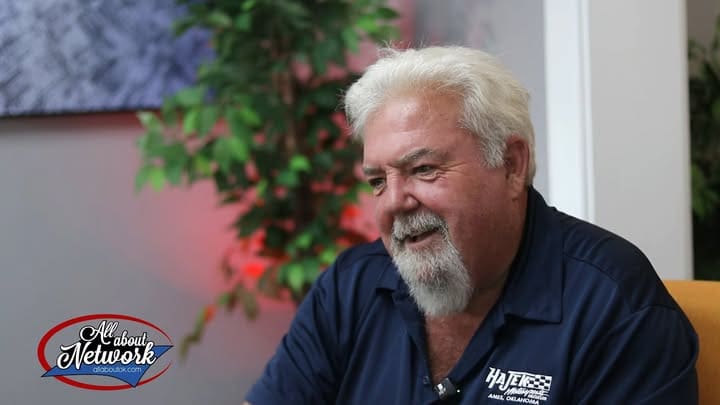
All About Network’s Jack Quirk recently sat down with longtime friend Hajek to talk about how a kid growing up around Hennessey, Oklahoma, became a collector, racer and caretaker of some of the most significant cars in American motorsports history.
For Hajek, it started during the car-crazy 1960s.
His uncle came home with a 1965 Shelby GT350 and proudly told young Brent it had more horsepower than three tractors. Around the same time, cousins and neighbors were driving big-block Fords and Dodges around the area.
“For a small town, there were quite a few cool cars and pickups around here,” Hajek recalled.
His own first car wasn’t exactly a beginner model, either, a 1969 428 Mustang. Even better, he still owns it today.
The collecting came almost by accident.
Hajek wanted to build a faster drag car but discovered it would actually be cheaper to buy an old Ford Thunderbolt Fairlane than build a Camaro or Mustang from scratch.
Today, a genuine Thunderbolt can easily be a six-figure collector car. Hajek remembers paying about $2,000 for his.
He didn’t buy it as an investment. He bought it because it was fast.
When he began taking the old car to drag strips, however, something unexpected happened. People recognized it.
That led to other historic cars, including one raced by legendary drag racer “Dyno Don” Nicholson. Before long, people were approaching Hajek at tracks with tips about where other forgotten race cars were sitting.
The collection grew, and so did Hajek’s connection with the National Hot Rod Association.
NHRA founder Wally Parks took an interest in what Hajek was doing and began having him bring historic cars to major events around the country. Hajek later learned Parks had Oklahoma roots of his own, growing up in Goltry and even knowing Hajek’s grandfather.
Through those events, Hajek began meeting the men whose names he had grown up reading about, including Bob Glidden, Gas Ronda, Jack Roush and others.
“The thing that really blew my mind,” Hajek said, was watching his childhood heroes eventually become his friends.
What began with a handful of cars stored at home eventually outgrew Hajek’s garage and shop. Then came an unusual opportunity, the former Ames school.
After the school consolidated with Lahoma to form Cimarron Schools, the building eventually went up for auction.
Hajek showed up.
So did nobody else.
He bought it.
Today, the former school houses the Hajek Motorsports Museum and more than 80 cars, although Hajek jokingly warned Quirk, “Don’t ask how many are running.”
The museum’s collection expanded beyond drag racing into NASCAR, with cars connected to racing legends including Richard Petty, Bobby Allison, Junior Johnson, Ned Jarrett and Bill Elliott. Hajek said three cars from his collection are currently displayed at the NASCAR Hall of Fame.
Quirk’s friendship with Hajek has led to some adventures of its own.
Years ago, Hajek called Quirk on Thanksgiving Day with an idea involving a Mustang, a dirt road and a rapidly approaching meeting with Ford executives.
Quirk soon learned that when Brent calls with an idea, you may only get half the story. The rest becomes clear somewhere along the way.
The resulting video helped Hajek land a deal with Ford and launched a years-long adventure involving Bonneville Salt Flats, Talladega Superspeedway, SEMA, wind-tunnel testing and land-speed records.
The Mustang eventually topped 250 mph at Bonneville with Danny Thompson driving, and later went to Talladega with NASCAR legend Bill Elliott behind the wheel.
At more than 200 mph, Elliott even introduced the Mustang to the Talladega wall.
“He scraped the wall a little bit,” Hajek said with considerable understatement.
For Quirk, one of the most personal surprises came the first time Hajek showed him the museum.
Growing up in Rhode Island, Quirk lived near the famous Tasca family, and grew up with the 3 Tasca boys. Tasca was one of the most influential Ford dealerships in the country, responsible for many of the Ford muscle cars that all became famous.
Quirk said, as a kid, “I remember standing at the bus stop watching the parade of cool Fords diving by on their way to work or school each day. On several occasions I missed the bus and recall riding to school in the legendary Tasca Street Boss Mustang.”
Decades later and roughly 1,600 miles away, Quirk walked into Hajek’s museum in Ames and found that very car.
“What the hell’s it doing in Ames?” Quirk remembered thinking.
It was one more example of how a little Oklahoma town somehow became a crossroads for racing history.
And that history isn’t just parked in rows.
One of the things that makes Hajek’s museum unusual is the documentation surrounding the cars. Visitors can see old magazines, photographs, posters and memorabilia that tell the stories of the vehicles and the people who raced them.
Hajek continues taking historic cars around the country to major racing events, doing for NASCAR much of what he began doing with NHRA decades ago, keeping the sport’s history in front of new generations of fans.
As Hajek put it, without the past, you don’t have a future.
The Hajek Motorsports Museum is normally available by appointment, although Hajek has his own description of the schedule.
“We’re never open,” Quirk joked.
“But we’re never closed,” Hajek quickly replied.
And that may be the best description of the museum, and Brent Hajek himself.
Somewhere inside an old school in tiny Ames, Oklahoma, sits a remarkable collection of American racing history, assembled by a guy who never really set out to build a museum.
He just liked fast cars.
Things got a little out of hand.
About The Author
